

Artificial Intelligence (AI) is the big dream: teaching machines to do things that normally require human intelligence. Talking, reasoning, recognizing faces, playing chess, writing poetry. It’s the goal: make computers smart.
Machine Learning (ML) is how you get there: and it’s where things get wild.
The Old Way vs. The ML Way
Imagine teaching a child what a cat is.
The old programmer’s way: Write 10,000 rules. “If it has pointy ears AND whiskers AND meows AND ignores you…” you get the idea. Exhausting. Brittle. Falls apart the moment a cat does something unexpected (which is always).
The ML way: Show the kid 1 million pictures of cats and say “trust the process.” The computer figures out the rules itself. Nobody told me about whiskers. It just… learned.
That’s machine learning instead of programming rules, you feed data and let the machine discover the patterns.
A Simple Analogy
Think of ML like training a new employee:
- Data = their past experience and examples you give them
- Model = their developing intuition
- Training = the months of practice and feedback
- Prediction = them making a judgment call on a new situation
The more good examples they see, the better their instincts get.
The Relationship: A Nested Hierarchy
Artificial Intelligence is the broad “umbrella” field. Machine Learning is a specific subset within that field, and Deep Learning (DL) is a further subset of Machine Learning.
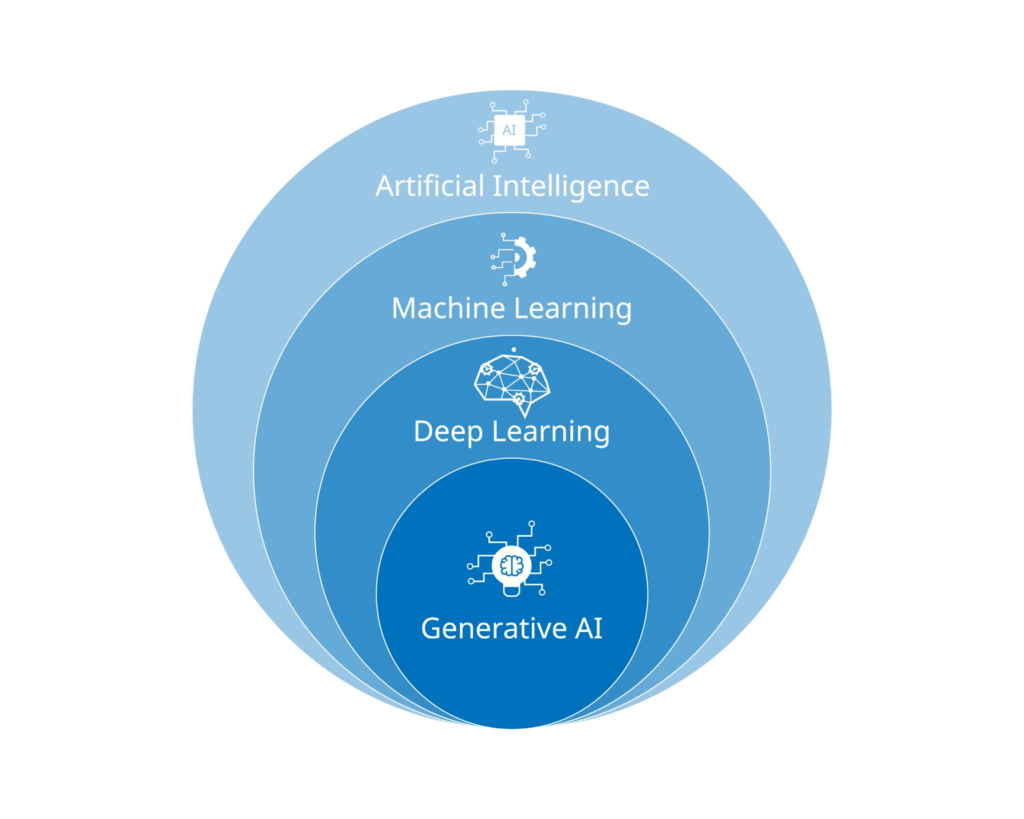
Alt tag: Visual diagram showing Machine Learning as a subset of Artificial Intelligence.
| Feature | Artificial Intelligence (AI) | Machine Learning (ML) |
| Definition | The broad concept of machines being able to carry out tasks in a “smart” or human like way. | A subset of AI based on the idea that we can give machines access to data and let them learn for themselves. |
| Goal | To simulate human intelligence to solve complex problems. | To learn from data to maximize the accuracy of a specific task. |
| Scope | Very broad (includes robotics, NLP, expert systems, etc.). | Limited to the development of algorithms that can learn from data. |
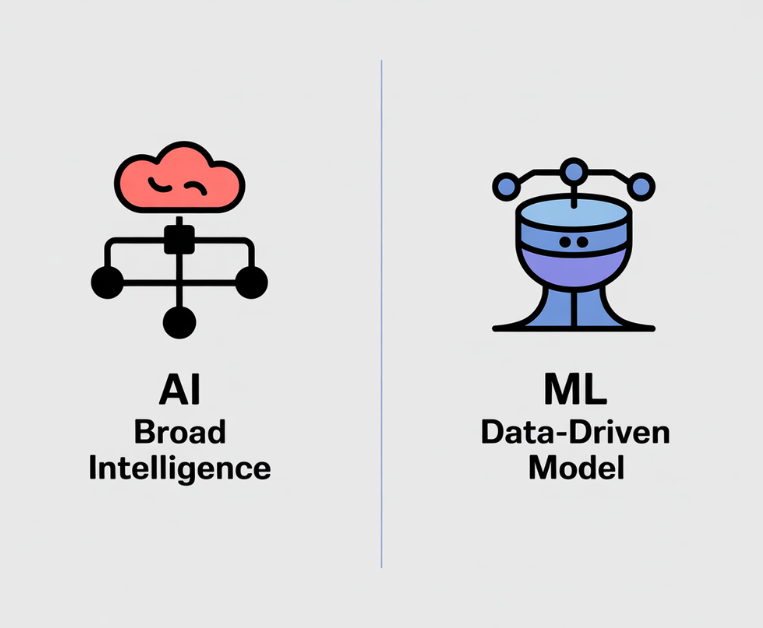
Alt tag: Infographic comparing Artificial Intelligence and Machine Learning
How AI and ML Work Together
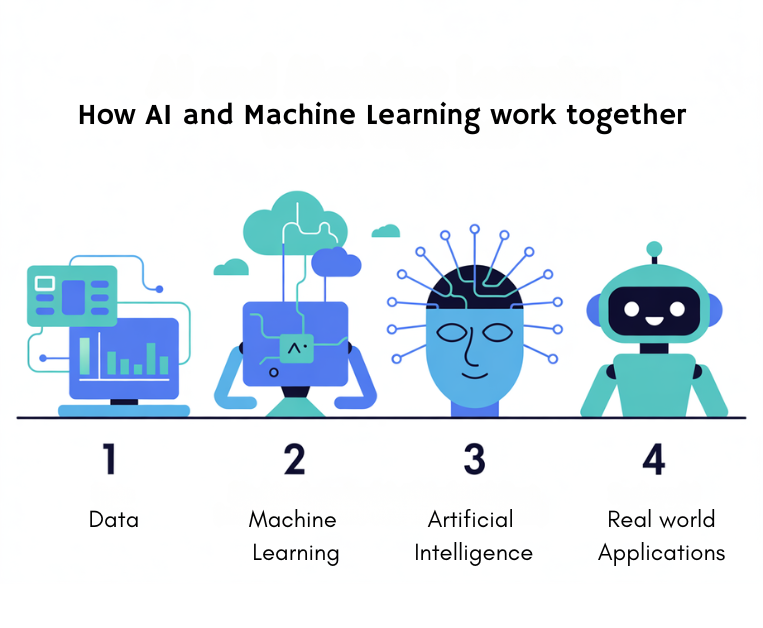
Alt tag: Side by side comparison chart of AI and MLwork together
AI vs ML: The Collaborative Workflow
The partnership usually follows a four step cycle where the AI acts as the interface or agent, and “ML” acts as the engine.The system gathers massive amounts of information (the “textbook”). Machine Learning algorithms sift through that data to find patterns.
It doesn’t need a human to tell it “if X happens, do Y.” Instead, it figures out that “X usually leads to Y. Once the patterns are identified, the AI uses that knowledge to perform a task like predicting a stock price or recognizing a face without being explicitly programmed for that specific instance.
If the AI makes a mistake, the error is fed back into the ML model. The model adjusts its internal logic, and the AI becomes “smarter” for the next attempt.
Types of Machine Learning
- Supervised Learning – learns to map inputs to known outputs, making it ideal for classification and regression tasks.
- Unsupervised Learning – works with unlabeled data, finding hidden patterns and structures.
- Reinforcement Learning – learns through trial and error, receiving rewards for correct actions.
Types of Artificial Intelligence
- Narrow AI (Weak AI) – designed for specific tasks.
- General AI (Strong AI) – human-like intelligence across multiple domains.
- Super AI – would surpass human intelligence in all aspects.
AI vs ML Engineer: Average Salary (Base Pay)
AI Engineer (U.S.)
• Typical base salary ~ $140,000 – $150,000 per year.
• Salary ranges widely depending on experience and location (~$90K – $250K+).
ML Engineer (U.S.)
• Typical base salary ~ $180,000 – $186,000 per year.
• Broader range seen in market data (~$110K – $310K+).
Choosing Between AI and ML for Your Project
If your goal is to create a system that feels “alive” and mimics human interaction, think of a diagnostic tool that talks to patients or a drone that navigates a forest you are building AI. You are choosing AI when the user experience and the final autonomous outcome are the priorities. You want a “brain” that can handle messy, real-world inputs and produce a smart, multi-layered response that solves a high-level problem.
On the flip side, if your project is less about “acting human” and more about “crunching reality,”
Machine Learning is your workhorse. This is the path when you have a mountain of data and need to predict the future, find a needle in a haystack, or classify items at a speed no human could match. If you want to know why customers are leaving your app or exactly what price a house should be, you don’t need a conversational robot; you need the statistical precision of an ML model.
The Future of AI and ML
The relationship between Artificial Intelligence and Machine Learning continues to evolve. As computing power increases and algorithms become more sophisticated, we’ll see even more impressive applications.
Agriculture: AI predicts crop yields, detects diseases, and optimizes irrigation smarter than any farmer could alone.
Space Exploration: ML analyzes telescope data and guides autonomous rovers across planets millions of miles away.
Engineering: AI accelerates design, simulates stress testing, and detects structural faults before they become disasters.
Healthcare: Models diagnose conditions from scans and signals faster and often more accurately than specialists.
Conclusion
The debate of AI vs ML is fundamental yet simple: Artificial Intelligence is the broad goal of creating intelligent machines, while Machine Learning is a specific method to achieve that goal through data driven learning. Both technologies are reshaping our world, offering unprecedented opportunities for innovation and growth.
Understanding these distinctions empowers you to make informed decisions about which technologies to adopt, how to implement them effectively, and what results to expect. As AI and ML continue to advance, staying informed about their capabilities and limitations becomes increasingly important for personal and professional success.
Whether you’re developing new applications, improving business processes, or simply staying informed about technological progress, grasping the relationship between Artificial Intelligence and Machine Learning is essential for navigating our increasingly automated world.