


| TL;DR Embedded is correct. Imbedded is a rare variant that means the same thing, but most style guides, dictionaries, and editors prefer embedded in all contexts. If you use imbedded, you are not wrong but you will stand out for the wrong reason. |
Introduction: A Spelling That Trips Everyone Up
This article settles the question for good. You will learn which spelling is standard, why the variant exists, when (if ever) imbedded is acceptable, and how to remember the correct form going forward.
Quick Answer: Embedded Is the Standard Spelling
Embedded is the correct, universally accepted spelling. Imbedded is a variant that some dictionaries acknowledge, but it is treated as non-standard by most style guides and avoided in formal, technical, and professional writing.
If you are writing anything that will be reviewed, published, or read by a professional audience, use embedded. Every time.
What Does ‘Embedded’ Actually Mean?
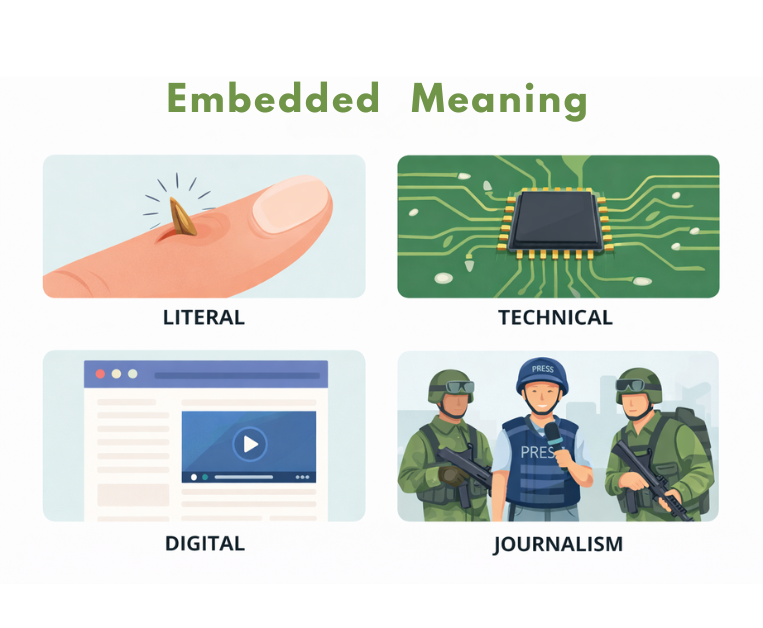
Before diving into the spelling debate, it helps to understand what the word means. Embedded comes from the verb embed, which means to fix something firmly and deeply inside a surrounding material or context.
You will encounter it in several distinct uses:
• Literal/physical: A splinter embedded in your finger. A fossil embedded in rock.
• Technical: An embedded system is a computer built into a larger device (think car brakes, medical monitors, smart appliances).
• Journalism: An embedded reporter travels with a military unit to report from within it.
• Digital/web: An embedded video is one inserted directly into a web page rather than linked externally.
• Figurative: A deeply held belief embedded in a culture.
In every single one of those uses, the correct spelling is embedded not imbedded.
Where Does ‘Imbedded’ Come From?
Imbedded is not a typo or a random error. It follows a real pattern in English. The prefix im- is extremely common, appearing in words like impossible, imprint, implant, and immerse. It is a form of in-, and it naturally leads some writers to assume the verb should be imbed rather than embed.
Historically, imbed has appeared in older texts, and some early dictionaries listed it as an acceptable form. Over time, however, the language standardized around embed. Today, imbed and its past tense imbedded are considered variant forms technically not wrong in the strict sense, but clearly non-standard.
The trend has only moved further toward embedded with time. Corpus data from large bodies of published text shows embedded outnumbering by a margin of roughly 50 to 1 in modern English usage.
What Do Major Style Guides Say?
Style guides do not spend much space on this question, which is itself telling because embedded is so clearly the standard that the debate barely registers.
• Merriam-Webster: Lists embed as the primary verb and acknowledges imbed as a variant. Embedded is the standard past tense and adjective.
• Oxford English Dictionary: Recognizes both embed and imbed, but notes embed is the dominant modern form.
• AP Stylebook: Does not list imbedded as acceptable. AP refers to embedded journalists, not imbedded ones.
• Chicago Manual of Style: No explicit entry, but general guidance favors standard dictionary forms which means embedded.
• APA Style (academic): Embedded is the accepted term, particularly in research contexts such as embedded clauses or embedded designs.
The short version: no major style guide endorses imbedded as a preferred form. Some tolerate it; none recommend it.
Embedded vs Imbedded: Side-by-Side Comparison
| Feature | Embedded | Imbedded |
| Spelling status | Standard, universally accepted | Variant, accepted but less common |
| Usage frequency | Very common | Rare |
| Formal writing | Always preferred | Best to avoid |
| Technical contexts | Required (e.g., embedded systems) | Never used |
| American English | Dominant form | Occasionally seen |
| British English | Dominant form | Very rare |
| SEO / digital content | Use this | Avoid |
Common Mistakes and How to Avoid Them
Mistake 1: Using ‘Imbedded’ in Technical Writing
In fields like software development, electronics, and engineering, embedded has a specific, established meaning. Embedded systems, embedded programming, embedded processors these are the accepted terms. Writing imbedded systems or an imbedded chip would immediately read as an error to any technical reader.
| Rule: In any technical context, embedded is the only correct form. Full stop. |
Mistake 2: Using ‘Imbedded’ in Published or SEO Content
Search engines and readers both recognize embedded as the standard form. If you are writing content optimized for search, using imbedded can signal lower editorial quality — and people searching for information about embedded video, embedded links, or embedded systems will be searching for exactly that spelling.
| Rule: For digital content and SEO purposes, always use embedded. |
Mistake 3: Assuming They Are Interchangeable in Academic Work
While imbedded is not technically incorrect, most academic editors will flag it and change it. Qualitative research uses the term embedded case study design. Statistics and linguistics both use embedded clauses and embedded variables. In every academic field, the standard form is embedded.
| Rule: Submit academic work with embedded, not imbedded, unless a specific journal or institution tells you otherwise. |
Embedded in a Sentence: Real Examples
Here is how the word looks in practice always using the standard spelling:
• The journalist traveled as an embedded reporter with the infantry unit for six weeks.
• She removed the shard of glass that had become embedded in her palm.
• The microcontroller runs on an embedded operating system designed for low-power devices.
• That assumption is so deeply embedded in the company culture that no one questions it anymore.
• To share the video, copy the embedded code and paste it into your website’s HTML.
• The research used an embedded case study design to examine three organizations within a single industry.
Notice that imbedded would look out of place in every single one of those sentences not because it changes the meaning, but because it draws attention to itself as unusual.
How to Remember the Correct Spelling
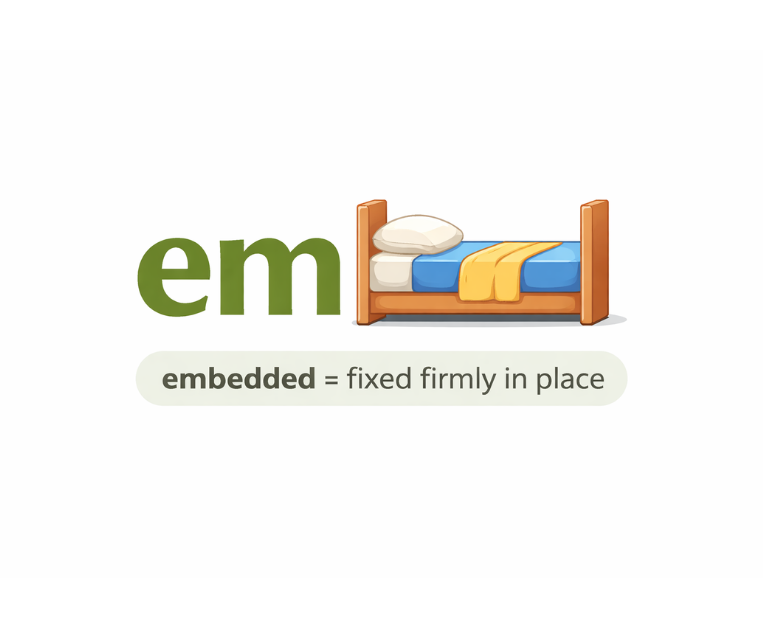
If you keep reaching for imbedded out of habit, here are a few ways to lock in the correct form:
• Think of the base word: The verb is embed, not imbed. Embedded is simply the past tense of embed. Once you know the base form, the spelling follows naturally.
• Associate it with bed: The word embed contains the word bed. Something embedded is fixed in place like a post set firmly in the ground. You would not say imbedded in bed; you would say embedded in place.
• Check your spellchecker: Most modern spellcheckers will flag imbedded or auto-correct it to embedded. If yours does not, add embedded to your preferred dictionary and imbedded to your personal block list.
When You Should (and Should Not) Use ‘Imbedded’
| When you might see imbedded: Historical texts, informal writing, or sources that predate the modern standardization around embedded. You may also encounter it in very casual contexts where spelling conventions are relaxed. |
| When you should never use imbedded: Technical writing, academic papers, journalism, marketing copy, SEO content, legal documents, or any professional context where editorial standards apply. |
Quick Decision Framework
Ask yourself these questions before you type the word:
• Am I writing for a professional, technical, or academic audience? → Use embedded.
• Is this content being published online or optimized for search? → Use embedded.
• Am I writing code documentation, a research paper, or a news article? → Use embedded.
• Am I writing a casual text or informal note where precision does not matter? → You can use either, but embedded is still the better habit.
The honest answer in every scenario: just use embedded. It is correct, it is standard, and it will never raise an eyebrow.
5 Quotable Rules of Thumb
• Embedded is the standard. Imbedded is the variant. When in doubt, go standard.
• The base verb is embed, not imbed. Follow the base.
• No major style guide recommends imbedded. That alone settles the argument for professional writing.
• In technical writing, embedded is not optional it is the field-specific term.
• Imbedded is not wrong; it is just unnecessary. Embedded does the job better, everywhere.
Pre-Publish Checklist: Embedded vs Imbedded
• Run a find-and-replace for ‘imbedded’ and change all instances to ’embedded’
• Check technical terms: embedded system, embedded programming, embedded journalist, embedded video
• Review academic usage: embedded case study, embedded clauses, embedded design
• Confirm your spellchecker is set to prefer ’embedded’
• If quoting a source that uses ‘imbedded,’ reproduce it accurately but note it is a variant
FAQ: Imbedded vs Embedded
| Question | Answer |
| Is ‘imbedded’ a real word? | Yes. It is an accepted variant of ’embedded,’ but far less common and generally avoided in formal or technical writing. |
| Which is correct: embedded or imbedded? | ‘Embedded’ is the standard, correct spelling in virtually all contexts. ‘Imbedded’ is technically valid but treated as non-standard by most style guides. |
| Why do people write ‘imbedded’? | It follows a natural pattern: the prefix ‘im-‘ is common in English (impossible, imprint). Writers sometimes extend it to ’embed’ out of habit. |
| Is ‘imbedded’ in the dictionary? | Some dictionaries list it as a variant. Merriam-Webster and Oxford both acknowledge ‘imbed,’ though they list ’embed’ as the primary form. |
| Can I use ‘imbedded’ in academic writing? | It is best to avoid it. Most academic style guides and editors will flag it as non-standard and change it to ’embedded.’ |
| What about ‘imbed’ vs ’embed’? | Same answer: ’embed’ is the correct, standard base form. ‘Imbed’ is the variant. Use ’embed’ in all professional, technical, and formal contexts. |
| Does ’embedded’ have a different meaning than ‘imbedded’? | No. They mean exactly the same thing. The difference is purely about spelling convention. |
| Are there regional differences? | Not significantly. Both American and British English prefer ’embedded.’ The variant ‘imbedded’ appears in neither dialect at any meaningful frequency. |
Conclusion
Imbedded and embedded mean exactly the same thing. The only difference between them is that embedded is standard English and imbedded is a non-standard variant that most readers, editors, and style guides will treat with suspicion.
There is no scenario in professional writing where imbedded is the better choice. It is not more precise. It is not more formal. It is not preferred in any regional dialect or industry context. It is simply the road less traveled and for good reason.
Use embedded. Your editors, your readers, and your spellchecker will thank you.
Sources and References
• Merriam-Webster Dictionary embed (verb), embedded (adjective)
• Oxford English Dictionary embed, imbed entries
• Associated Press Stylebook embedded journalists’ usage
• Google Ngram Viewer frequency comparison: embedded vs imbedded (1900–2019)
• Chicago Manual of Style, 17th Edition general word usage guidance• APA Publication Manual, 7th Edition embedded case study design terminology