


| TL;DR: AI chatbot development services help businesses build custom bots that handle customer queries, qualify leads, and automate repetitive tasks 24/7, without burning out. If you’re evaluating an AI chatbot development company, this guide walks you through what to look for, how the development process works, costs involved, and what separates a chatbot that converts from one that frustrates. |
Your customers don’t want to wait. They want answers now at 2 AM on a Sunday, in the middle of a checkout, or right when they’re about to bounce from your pricing page. That’s exactly the problem AI chatbot development services are built to solve.
This guide is written for business owners, product managers, and decision-makers who are seriously evaluating custom chatbot development not just tire-kicking. By the end, you’ll understand what AI chatbot development actually involves, how to choose the right company, what realistic costs look like, and how agencies like Devomech build chatbots that deliver measurable ROI.
What’s Inside This Guide:
- What AI chatbot development services actually include
- Why off-the-shelf chatbots fall short
- How the development process works (step by step)
- AI chatbot development company comparison (approaches vs. costs)
- What Devomech does differently and a real project you can review
- Common mistakes companies make when building chatbots
- How to choose the right chatbot partner for your business
- FAQ 8 questions real buyers ask
1. What Are AI Chatbot Development Services?
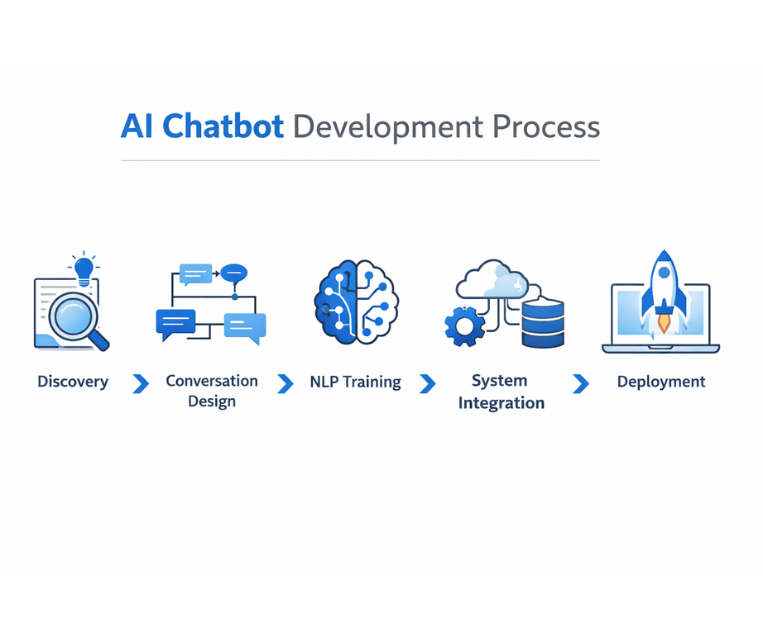
AI chatbot development services refer to the end-to-end process of designing, building, training, and deploying a conversational AI system tailored to a specific business use case. This is not a template you install and forget it’s a custom software product.
A full-service AI chatbot development company typically handles:
- Natural Language Processing (NLP) training: Teaching the bot to understand what users actually mean, not just what they literally type.
- Conversation flow design: Mapping out how the bot should respond across hundreds of possible user paths.
- System integrations: Connecting the chatbot to your CRM, helpdesk, ecommerce platform, or internal database so it gives real, contextual answers.
- Platform deployment: Launching across web, mobile, WhatsApp, Slack, or whatever channel your customers use.
- Ongoing training and optimization: Monitoring conversations and improving accuracy over time.
| Rule of Thumb: If a chatbot can’t access your actual data and can’t handle at least 70–80% of your most common queries without human intervention, it isn’t doing its job. |
2. Why Off-the-Shelf Chatbot Tools Often Fall Short
Platforms like Intercom, Drift, and ManyChat have their place especially for simple FAQ bots or basic lead capture. But they hit a ceiling fast when your needs get even slightly complex.
Here’s where pre-built tools struggle:
- Industry-specific language: Generic bots aren’t trained on your domain vocabulary. A chatbot for a logistics company needs to understand freight terminology. A chatbot for a healthcare clinic needs to handle sensitive queries with care.
- Deep system integrations: Most SaaS chatbots offer shallow integrations. They can’t pull a customer’s real-time order status, check inventory, or trigger actions in your internal systems.
- Scalability: As your product evolves, so do user queries. Pre-built tools make it painful to retrain or expand the bot’s capabilities.
- Brand voice: A generic bot sounds generic. Custom development means your chatbot sounds like your brand.
That’s the core reason companies turn to a dedicated AI chatbot development company. They need something built around their business, not around the lowest common denominator.
3. How AI Chatbot Development Works: Step by Step
Understanding the development process helps you ask better questions when evaluating vendors. Here’s how a structured engagement typically looks:
Step 1: Discovery & Requirements Mapping
Before a single line of code is written, the team needs to understand your use case. What queries should the bot handle? What systems does it need to talk to? What does success look like deflection rate, CSAT score, leads generated?
Step 2: Conversation Architecture Design
This is the blueprint phase. Developers and UX designers map out every conversation flow including edge cases, fallbacks when the bot doesn’t understand, and escalation paths to human agents.
Step 3: NLP Model Training
The bot is trained on real examples of how your customers ask questions. The more domain-specific training data you provide (support tickets, chat logs, FAQs), the better the model performs out of the gate.
Step 4: Backend Integration
This is where the bot gets connected to your actual systems: your CRM, order management system, knowledge base, or any internal APIs. Without this, you just have a fancy FAQ page.
Step 5: Testing & QA
The bot is stress-tested across hundreds of scenarios. Developers look for broken flows, incorrect answers, and edge cases that could embarrass your brand.
Step 6: Deployment & Monitoring
The bot goes live. But deployment isn’t the finish line; ongoing monitoring is how you catch low-confidence responses and continuously improve accuracy.
| Pro Tip: Ask any AI chatbot development company you’re evaluating how they handle the ‘I don’t know’ scenario. A good bot gracefully admits its limits and hands off to a human. A bad bot confidently gives wrong answers. |
4. Approaches to AI Chatbot Development: A Comparison
Not all chatbot builds look the same. Here’s a clear breakdown of the main approaches so you can match one to your situation:
| Approach | Description | Timeline | Cost | Flexibility |
|---|---|---|---|---|
| Custom AI Chatbot | Full custom build | 8–16 weeks | High | Maximum |
| SaaS Chatbot Tool | Plug-and-play platform | 1–3 days | Low/Medium | Moderate |
| Open-Source Framework | Self-hosted solution | 4–8 weeks | Medium | High |
| Hybrid Approach | Custom + platform combo | 4–10 weeks | Medium | High |
For most mid-size and enterprise businesses, a custom or hybrid approach built by an experienced AI chatbot development company delivers the best long term value.
5. What Devomech Does Differently
Devomech is an AI chatbot development company that focuses on building production-ready, business-integrated bots, not demo-quality prototypes that fall apart in the real world.
Experience That Translates to Results
The team has worked across industries including ecommerce, logistics, SaaS, and professional services. That cross-domain experience means they’ve already solved most of the hard problems before your project even starts.
Full-Stack Development, Not Just the Bot
A chatbot is only as useful as the systems it’s connected to. Devomech handles backend integrations natively, not outsourcing the messy API work to a third party.
Transparent Process
From requirements to deployment, clients get visibility into what’s being built and why. No black boxes, no surprise scope changes at the end of an engagement.
Want to see this in action? Check out their AI bot project portfolio to see a real-world example of how they’ve approached conversational AI development for a client.
| EEAT Signal: Devomech’s team has hands-on experience across NLP model training, API integration, and multi-platform bot deployment. Their portfolio includes live, client-deployed projects — not just concept demos. |
6. AI Chatbot Development Cost: What’s Realistic?
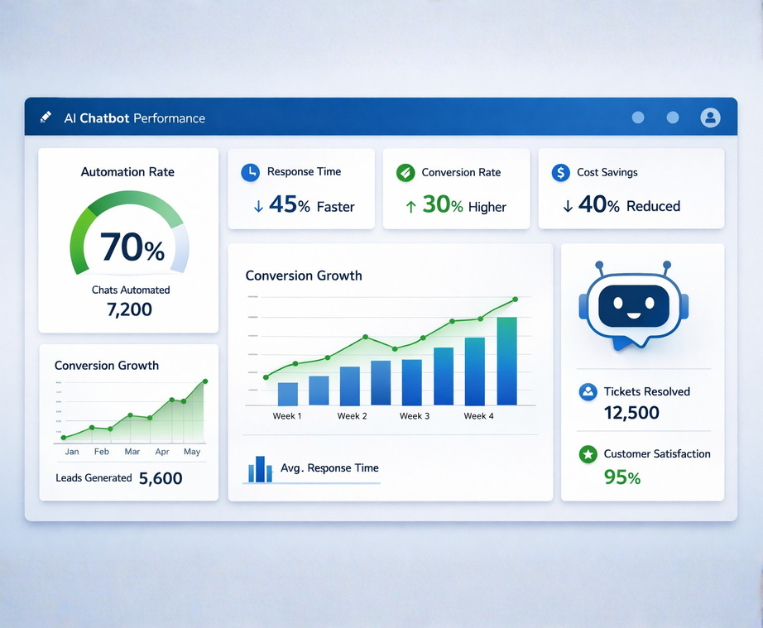
Cost varies dramatically based on complexity. Here are honest ranges as of 2025:
- Simple FAQ bot (rule-based, no integrations): $3,000 – $8,000
- Mid-complexity bot (NLP + 1–2 integrations): $10,000 – $30,000
- Enterprise-grade bot (multi-system, multi-channel, custom NLP): $40,000 – $150,000+
- Ongoing retainer (monitoring, retraining, feature additions): $1,500 – $5,000/month
Be skeptical of very low quotes; they usually mean shallow integrations, limited training data, or a template with minimal customization. A chatbot that genuinely deflects 60–70% of support tickets pays for itself within months.
7. Common Mistakes When Building a Chatbot
These are the most expensive errors businesses make often learned the hard way:
- Skipping the conversation design phase: Jumping straight to development without mapping flows leads to bots that handle only the happy path and fall apart on real user behavior.
- Training on too little data: A bot trained on 20 example queries will be fragile. You need breadth and variation in your training data.
- No escalation path: If the bot can’t solve a problem, it needs to hand off to a human cleanly. Without this, frustrated users just leave.
- Ignoring post-launch performance: Most chatbot improvements happen after launch, based on real conversation data. Set-it-and-forget-it is a recipe for decay.
- Treating it as a one-time project: User needs evolve. Your bot should too. Budget for ongoing training and iteration.
8. How to Choose the Right AI Chatbot Development Company
Here’s a practical checklist for evaluating vendors before you sign anything:
Pre-Vendor Evaluation Checklist
- Portfolio with live, deployed bots: Not just mockups. Ask for links or demos.
- Experience in your industry or a comparable one: Domain knowledge accelerates development and reduces errors.
- Clear process documentation: Can they explain their workflow without vague terms?
- Integration capability: Have they built integrations with systems similar to yours?
- Transparent pricing model: Fixed project fee or hourly? Understand how scope changes are handled.
- Post-launch support: What does ongoing maintenance look like? Is it included or an add-on?
- Data privacy and security: How is customer conversation data handled and stored?
If you want to start by reviewing real work rather than sales decks, Devomech’s AI chatbot project page shows how they approach conversational AI for real clients.
When You Should (and Shouldn’t) Build a Custom Chatbot
Build a custom chatbot if:
- You have high query volume (500+ support tickets/month) that’s straining your team
- Your use case requires real-time data from internal systems
- You operate in a specialized industry where generic bots fail
- You want full control over conversation design and brand voice
- You’re looking at long-term cost reduction in support or sales operations
Stick with a SaaS chatbot tool if:
- You need a basic FAQ bot up in a few days
- Your query types are simple and predictable
- Budget is tight and complexity is low
- You’re testing chatbot ROI before committing to a full build
FAQ: AI Chatbot Development Services
Q: How long does it take to build a custom AI chatbot?
A straightforward bot with basic integrations can be built in 6–10 weeks. A fully integrated enterprise chatbot typically takes 12–20 weeks depending on system complexity and training data availability.
Q: What’s the difference between a rule-based chatbot and an AI chatbot?
Rule-based chatbots follow fixed decision trees if the user says X, the bot says Y. AI chatbots use NLP to understand intent, meaning they can handle unpredictable phrasing and more complex queries without breaking.
Q: Can a chatbot integrate with my existing CRM or helpdesk?
Yes, this is standard practice for any serious AI chatbot development company. Common integrations include Salesforce, HubSpot, Zendesk, Freshdesk, Shopify, and custom APIs.
Q: How is chatbot performance measured?
Key metrics include containment rate (queries resolved without human intervention), CSAT score, average resolution time, and fallback rate (how often the bot says it doesn’t know).
Q: Do I need AI/ML expertise to work with a chatbot development agency?
No. A good agency handles all the technical work. You need to be able to provide input on your business use case, customer query types, and system access. The technical execution is the agency’s job.
Q: Will the chatbot learn on its own over time?
Modern AI chatbots can improve with additional training, but they don’t magically self-improve without human oversight. Ongoing retraining based on conversation logs is how accuracy improves over time.
Q: What platforms can a custom chatbot be deployed on?
Most AI chatbots can be deployed across web chat, mobile apps, WhatsApp, Facebook Messenger, Telegram, Slack, and Microsoft Teams depending on where your users are.
Q: How do I know if a chatbot vendor is worth hiring?
Look at their deployed work, ask for references, and test their own chat interfaces. If they can’t show you live examples, that’s a red flag.
If X → Do Y: Quick Decision Guide
- If your support team handles 500+ repetitive queries/month → Invest in a custom AI chatbot. The ROI timeline is typically under 12 months.
- If you need real-time data in bot responses → Custom development is required. SaaS tools won’t cut it.
- If your budget is under $5,000 → Start with a SaaS tool and upgrade once you’ve proven chatbot ROI.
- If you’re in a regulated industry (healthcare, finance, legal) → Prioritize vendors with data privacy compliance experience.
- If you want to see a real example before deciding → Review Devomech’s AI bot project at devomech.com/ai-bot/ first.
Next Steps & Related Guides
Now that you understand what AI chatbot development services involve, here’s where to go next:
- Review a real chatbot project: Devomech AI Bot Portfolio
- Define your use case write down your top 20 most common customer queries
- Audit your existing systems know what APIs and integrations will be required before your first call with any agency
- Set a realistic budget range before approaching vendors so you can filter immediately
- Request proposals from 2–3 agencies and compare their discovery process, not just their pricing
About Devomech: Why Trust This Guide
Devomech is an AI and software development company specializing in custom AI chatbot development services for businesses that need more than off-the-shelf tools can offer. Their team has built and deployed conversational AI solutions across ecommerce, logistics, SaaS, and service industries.
This guide was written based on hands-on experience building and deploying AI chatbots for real clients. You can evaluate that experience directly by visiting their AI bot project portfolio.
Sources & References
- IBM Global AI Adoption Index 2024: enterprise chatbot adoption trends
- Gartner Conversational AI Market Guide (as of 2024): platform landscape and deployment patterns
- Salesforce State of Service Report 2024: chatbot ROI and containment rate benchmarks
- Devomech AI Bot Project: https://devomech.com/ai-bot/