

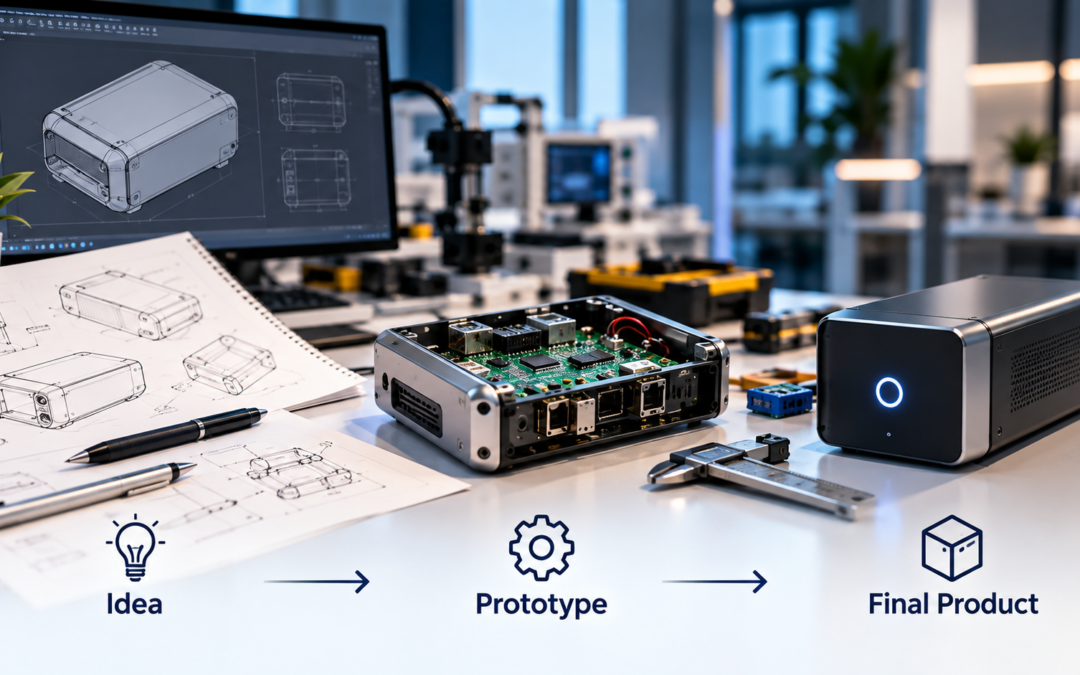
Turning an idea into a successful physical or digital product requires more than simply having a great concept. Before moving into full-scale manufacturing, businesses need to understand how the product will look, function, perform, and respond to real-world conditions.
This is where a product prototype becomes valuable. A prototype provides an early version of a product that can be evaluated, tested, and improved before committing significant resources to final production.
Whether you are developing an IoT device, electronic product, smart device, or another engineered solution, product prototype development helps bridge the gap between an initial concept and a production-ready product.
What Is a Product Prototype?
A product prototype is an early physical or digital representation of a product. It is created to demonstrate how a product may look, work, or behave before the final version is manufactured.
Depending on the project, a prototype can range from a simple model used to demonstrate an idea to a functional prototype containing electronics, software, mechanical components, or connectivity features.
The purpose is not necessarily to create a perfect final product immediately. Instead, product prototyping allows engineering teams to identify problems, test assumptions, gather feedback, and make improvements early in the product development process.
Why Is Product Prototyping Important?
Developing a product without testing its concept can result in expensive changes later. A prototype allows businesses to discover potential issues before they become difficult or costly to fix.
Some key benefits include:
1. Validate the Concept
A prototype can show whether an idea is technically practical and whether the proposed design works as intended.
2. Identify Design Problems
Testing an early version can reveal issues with functionality, usability, dimensions, materials, electronics, or performance.
3. Reduce Development Risks
Finding problems during early stages can help reduce the risk of making major changes after manufacturing has already begun.
4. Gather Feedback
Functional prototypes can be presented to stakeholders, customers, investors, or testing teams to collect valuable feedback.
5. Prepare for Manufacturing
A well-developed prototype can help engineers refine the design and prepare the product for a smoother transition toward manufacturing.
The Product Prototype Development Process
The exact process varies depending on the product, but most projects follow several key stages.
1. Define the Product Requirements
The process begins by understanding what the product needs to achieve.
This may include:
- Product functionality
- Target users
- Technical requirements
- Size and dimensions
- Materials
- Connectivity requirements
- Power requirements
- Environmental conditions
- Expected production quantity
- Target manufacturing cost
Clearly defining these requirements gives the engineering team a foundation for the project.
2. Develop the Initial Design
Once the requirements are established, engineers and designers can begin developing the product concept.
Depending on the project, this may involve CAD modelling, electronic design, PCB development, mechanical design, software development, or UI/UX design.
At this stage, the focus is on turning the initial concept into a technically defined design.
3. Build the Prototype
The next stage is prototype development, where the proposed design is transformed into a physical or functional model.
For an electronic product, this could involve developing a PCB, integrating sensors, connecting a microcontroller, developing firmware, and creating an enclosure.
For a mechanical product, it may involve CAD modelling, machining, 3D printing, or other fabrication methods.
The prototype should be built around the specific features that need to be tested.
4. Test and Evaluate
Once the prototype is ready, it needs to be tested.
Testing may examine:
- Functionality
- Performance
- Reliability
- Usability
- Electrical behaviour
- Mechanical performance
- Connectivity
- Temperature or environmental resistance
- Power consumption
Testing helps identify areas where the design does not perform as expected.
5. Refine the Design
The first prototype rarely represents the final product perfectly.
Test results are used to identify improvements and create an updated version. Components may be changed, dimensions adjusted, software modified, or the overall design refined.
This process may be repeated several times depending on the complexity of the product.
6. Prepare for Manufacturing
Once the design has been sufficiently tested and refined, the product can move toward production.
At this stage, engineering teams may review component availability, manufacturing methods, assembly requirements, production costs, quality requirements, and design-for-manufacturing considerations.
The goal is to ensure that the product is not only functional but also practical to manufacture at the intended scale.
Types of Product Prototypes
Different products require different approaches to prototyping. Common types include:
Proof-of-Concept Prototype
A proof-of-concept prototype demonstrates whether the core technical idea is possible.
It may not have the appearance or complete functionality of the final product.
Functional Prototype
A functional prototype focuses on demonstrating how the product actually works. It can include working electronics, software, mechanical components, or other essential systems.
Visual Prototype
A visual prototype focuses primarily on the product’s appearance, size, shape, and physical design.
Engineering Prototype
An engineering prototype is developed to test technical performance and prepare the design for further development and manufacturing.
In many real-world projects, several prototype types may be created throughout the development process.
When Should You Build a Product Prototype?
A prototype can be useful whenever there is uncertainty about whether a product concept will work as intended.
For example, you may want to prototype when:
- Developing a new electronic device
- Creating an IoT product
- Testing a new mechanical design
- Developing a smart product
- Integrating hardware and software
- Validating a new product concept
- Preparing a product for manufacturing
- Testing a new PCB design
Building a prototype early can provide valuable technical information before significant investment is made in large-scale production.
How Product Prototyping Supports Product Development
Product prototyping should not be treated as a completely separate activity from product development. It is an important part of the wider development cycle.
The process can be viewed as:
Idea → Requirements → Design → Prototype → Testing → Refinement → Manufacturing
Each stage provides information that can influence the next one. Testing a prototype, for example, may reveal that a component needs to be changed or that the original design needs modification.
This iterative approach helps engineering teams progressively improve the product instead of attempting to solve every technical challenge at the beginning.
Choosing Prototype Development Services
When working with an external engineering partner, it is important to consider the capabilities required for your specific product.
Depending on your project, prototype development services may include:
- Product design
- Mechanical engineering
- PCB design
- Embedded systems
- Firmware development
- IoT development
- 3D modelling
- Rapid prototyping
- Functional testing
- Product refinement
- Manufacturing support
A development partner with capabilities across multiple engineering disciplines can help coordinate different parts of the product instead of treating hardware, software, and mechanical development as completely separate projects.
From Prototype to Production
Creating a prototype is an important milestone, but it is not the end of the product journey.
A successful transition from prototype to production requires additional consideration of manufacturing processes, component sourcing, quality control, scalability, costs, and regulatory requirements where applicable.
The earlier these factors are considered, the easier it can be to identify potential production challenges and make appropriate design decisions.
Build Your Product Idea With the Right Engineering Process
A strong product starts with a well-defined idea, but turning that idea into something real requires structured engineering, testing, and refinement.
A product prototype provides a practical way to test an idea before moving into larger-scale production. Through product prototype development, businesses can validate concepts, identify technical challenges, improve designs, and move toward a more reliable final product.
Whether you are developing an electronic device, IoT solution, mechanical product, or integrated hardware system, the right prototype development approach can help transform an early concept into a product that is ready for the next stage of development.