

TL;DR
IoT product development turns an idea into a physical device that senses, connects and shares data with an app or cloud platform. It combines hardware, firmware, connectivity, cloud software, security and certification, and all of them must work as one system. Successful connected products start with a clear use case, choose connectivity and power early, build in security from day one and plan for manufacturing and updates long before launch.
Introduction
A smart thermostat, a fleet tracker, a vibration sensor on a factory pump and a connected wearable have one thing in common: each is a physical product that only delivers its full value when it is online.
That is what makes IoT product development different from building a standalone electronic device or a pure software app. A connected product has to work in the real world (on a battery, in heat or dust, behind a weak signal) while staying secure and updatable for years. An early hardware choice, such as the radio module or battery size, can limit what the software can do later, and the reverse is also true.
This guide explains what IoT product development involves, the process from concept to production, how to choose connectivity, which security rules now apply, what drives cost and how to choose the right development partner.
1. What Is IoT Product Development?
IoT (Internet of Things) product development is the end-to-end process of designing, building, testing and manufacturing a device that collects data or performs actions and exchanges information over a network.
The device is only one part of the product. Users experience the whole chain: the sensor reading, the wireless link, the cloud processing and the dashboard or mobile app. IoT device development therefore needs electronics, mechanical, firmware, cloud and app engineers working from one shared set of requirements.
Typical examples include:
- Smart home devices such as thermostats, locks and energy meters
- Industrial sensors for predictive maintenance
- GPS and cellular asset trackers
- Connected medical and wellness wearables
- Smart agriculture and smart retail devices
2. The Building Blocks of an IoT Product
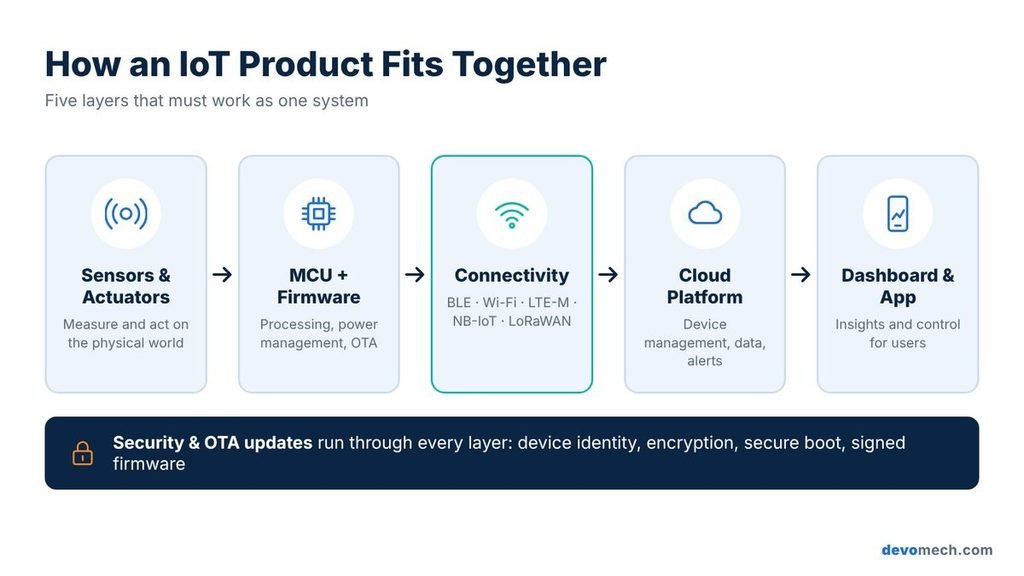
Every connected product is built from the same core layers. Treating them as one system, rather than separate projects, is the key to a reliable result.
- Hardware: sensors, actuators, microcontroller, power circuitry, antenna and the PCB.
- Mechanical design: enclosure, sealing (IP rating), heat management and materials.
- Firmware: embedded software for sensing, power management, communication and over-the-air (OTA) updates.
- Connectivity: BLE, Wi-Fi, LTE-M, NB-IoT, LoRaWAN or a wired link.
- Cloud and applications: device management, data storage, alerts, dashboards and mobile apps.
- Security: device identity, encryption, secure boot and a way to fix vulnerabilities after launch.
3. The IoT Product Development Process: Step by Step
A structured IoT product development process reduces late surprises, such as a battery that lasts weeks instead of years or a design that fails certification.
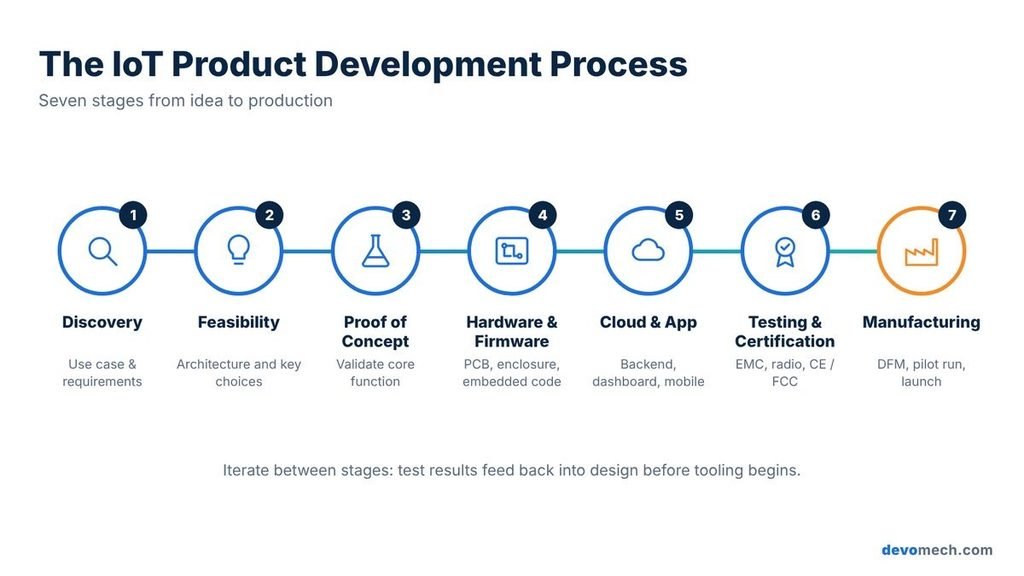
Step 1: Discovery and requirements
Start with the problem, not the technology. Define the users, the installation environment, what the device must measure or control, and the target unit cost, volume, battery life and markets.
Step 2: Feasibility and architecture
Make the big trade-offs: microcontroller, connectivity, battery or mains power, edge or cloud processing, and cloud platform. A short feasibility study here often saves months later.
Step 3: Proof of concept
Use development boards and off-the-shelf sensors to prove that the core function works in the real location. Our guide to product prototype development explains how prototypes reduce risk at this stage.
Step 4: Hardware and firmware development
Engineers design the custom PCB and enclosure while firmware engineers build sensing, power management, communication, security and OTA updates. Close collaboration matters: antenna performance, for example, depends on both the PCB layout and the enclosure material.
Step 5: Cloud and app development
The backend handles device onboarding, data, alerts and users, while the dashboard or app turns raw data into decisions. Plan for scale: a system that works for ten devices may struggle at ten thousand.
Step 6: Testing and certification
Test the complete system: function, battery life, range, temperature, humidity, drop, ingress, security and pre-compliance for EMC and radio. Formal certification, such as CE marking in Europe or FCC in the US, follows.
Step 7: Manufacturing and lifecycle support
Design for manufacturing (DFM) and a pilot run validate assembly, end-of-line testing and device provisioning. After launch, the team monitors the fleet, ships firmware updates and fixes security issues.
4. Choosing the Right Connectivity
Connectivity affects battery life, range, unit cost, running cost and certification effort, which makes it one of the earliest decisions in IoT hardware design.
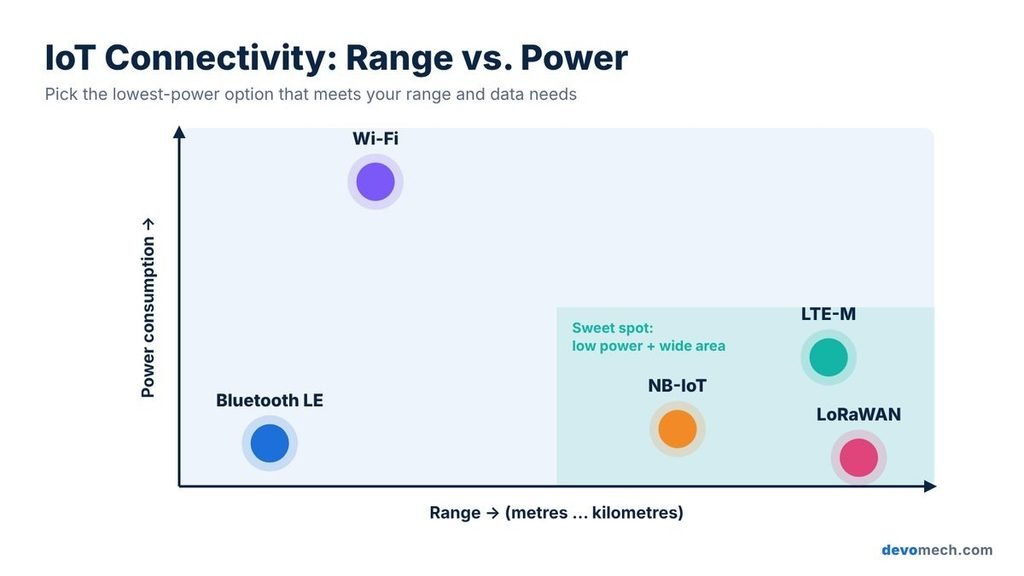
| Technology | Range | Power use | Best suited for |
| Bluetooth Low Energy | Short | Very low | Wearables and phone-connected devices |
| Wi-Fi | Short to medium | High | Mains-powered home and office devices |
| LTE-M | Wide (cellular) | Low to medium | Trackers and mobile assets |
| NB-IoT | Wide, good indoor reach | Very low | Static meters and sensors |
| LoRaWAN | Long (kilometres) | Very low | Agriculture, smart city and campus sensors |
Rule of thumb: choose the option that meets your range and data needs with the lowest power use. For more on cellular options, see our comparison of LTE vs. NB-IoT & LTE-M.
5. Security and Compliance: Now a Legal Requirement
Security is no longer optional for connected products, especially in Europe:
- Radio Equipment Directive (RED): since 1 August 2025, wireless devices sold in the EU must meet cybersecurity requirements, supported by the EN 18031 standards.
- Cyber Resilience Act (CRA): manufacturers must report actively exploited vulnerabilities from 11 September 2026, and full secure-by-design and update obligations apply from 11 December 2027.
In practice, secure IoT device development means unique device credentials instead of default passwords, encrypted communication, secure boot, signed OTA updates, a vulnerability-handling process and GDPR-friendly data collection. Building these in at the architecture stage is far cheaper than adding them later.
6. What Affects the Cost of IoT Product Development?
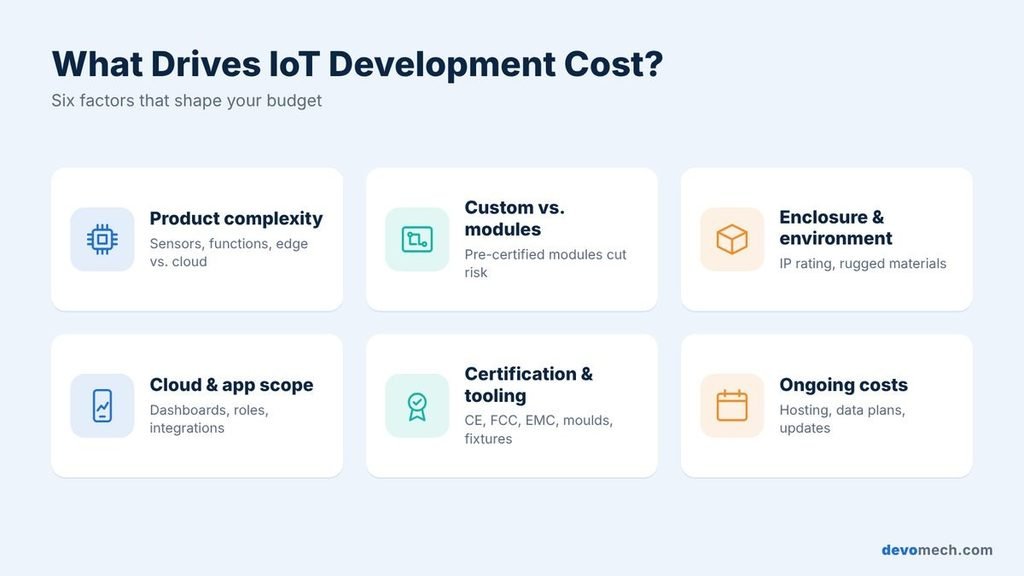
Every connected product combines different hardware, software and compliance work, so there is no fixed price. The main cost drivers are:
- Product complexity: number of sensors and functions, and edge vs. cloud processing.
- Custom hardware vs. pre-certified modules: modules cost more per unit but reduce certification risk.
- Enclosure and environment: waterproof, rugged or industrial ratings add design and tooling cost.
- Cloud and app scope: dashboards, user roles and integrations.
- Certification and manufacturing: CE, FCC, EMC, moulds, test fixtures and volume.
- Ongoing costs: hosting, connectivity fees and firmware updates over the product’s life.
7. Common Mistakes to Avoid
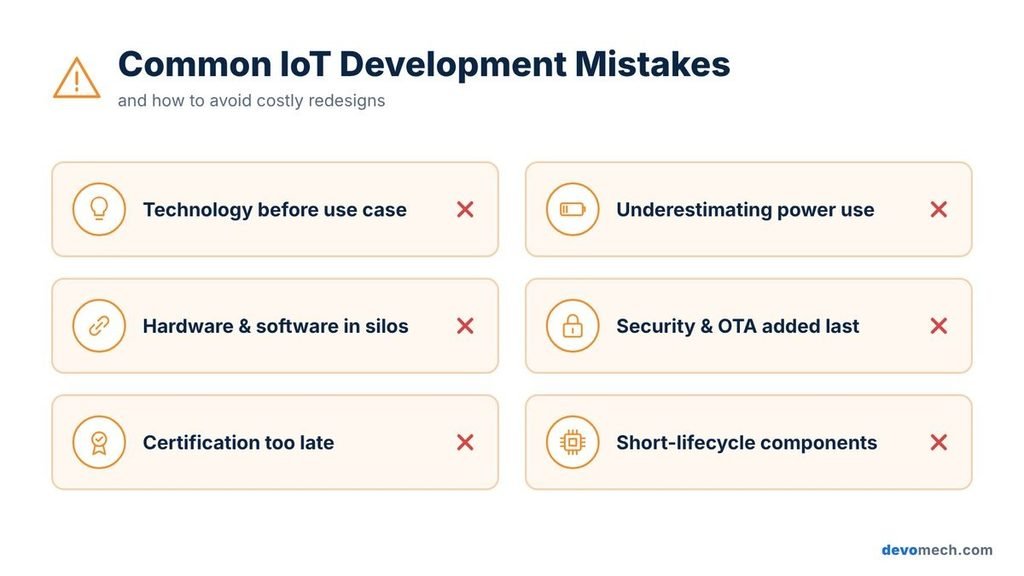
- Starting with technology instead of the use case.
- Underestimating power consumption: paper calculations rarely match real radio conditions.
- Treating hardware and software as separate projects: integration problems then appear late.
- Leaving security, OTA updates or certification until the end: fixes may require a redesign.
- Choosing components with short availability: end-of-life parts can stop production.
8. How to Choose an IoT Product Development Company
Because connected product development spans so many disciplines, your partner directly affects time to market and quality. Look for:
- End-to-end capability: electronics, PCB, firmware, mechanical, cloud and app development.
- Relevant experience with similar power, connectivity or environmental needs.
- A clear process with defined stages, milestones and documentation.
- Compliance knowledge: CE, RED, CRA and your target market’s certifications.
- Manufacturing readiness and long-term support for updates and new versions.
Frequently Asked Questions
How long does IoT product development take?
A proof of concept can often be built in a few weeks, while a production-ready connected product usually takes several months or more, depending on complexity and certification.
How much does it cost to develop an IoT product?
It depends on hardware complexity, connectivity, software scope, certification and volume. The most reliable figure is an estimate based on your specific requirements.
Which connectivity is best for an IoT device?
There is no single best option. BLE suits phone-connected devices, Wi-Fi suits mains-powered indoor products, LTE-M and NB-IoT suit cellular use, and LoRaWAN suits long-range, low-data sensors.
Do IoT devices need certification?
Yes. Devices sold in the EU need CE marking, including the Radio Equipment Directive’s cybersecurity requirements for wireless products. Devices sold in the US need FCC authorisation.
Can an existing product be made “smart”?
Often, yes. Adding a communication module, new firmware and a cloud platform can connect many products, although the enclosure and power design may need changes.
Next Steps: Turning Your Idea into a Connected Product
- Define the problem your product solves and who it is for.
- List must-have features and the operating environment.
- Set targets for unit cost, battery life and volume.
- Identify your markets and their certification requirements.
- Validate the riskiest assumption with a proof of concept.
- Discuss architecture and a roadmap with an experienced engineering team.
How Devomech Can Help
Devomech brings electronics, firmware, mechanical design and software engineering together under one roof. Our IoT product development services cover everything from concept and prototyping to PCB design, embedded firmware, IoT app development, hardware product design and preparation for manufacturing.
Planning a connected device? Contact Devomech to discuss your requirements and the best path from idea to market.
Sources & References
- European Commission: Cyber Resilience Act (Regulation (EU) 2024/2847)
- European Commission: Delegated Regulation (EU) 2022/30 under the Radio Equipment Directive
- CEN-CENELEC: EN 18031-1, -2 and -3 cybersecurity standards for radio equipment
- Devomech website: devomech.com