

TL;DR
AI product development means creating a product or software solution that uses artificial intelligence to solve a specific problem. The process includes defining the business need, checking feasibility, choosing an appropriate AI approach, building and testing a solution, and improving it after launch. The goal is a useful, reliable product—not simply adding AI for its own sake.
Introduction
Employees may spend hours reviewing documents, customers may wait too long for answers, or teams may struggle to find patterns in large amounts of data. These challenges can slow operations, increase costs, and limit growth.
Artificial intelligence can help with some of these problems, but choosing a technology is only one part of the work. Businesses must also define the outcome they need, understand the available data, and plan how the solution will fit into existing operations.
This is where AI product development comes in. A well-planned process connects a business objective with suitable AI capabilities, software, data, and user experience. This guide explains when AI may be useful, how development works, what to consider before investing, and how to choose a development partner.
1. What Is AI Product Development?
AI product development is the process of designing and building a product or software solution that uses artificial intelligence to interpret information, generate outputs, identify patterns, or support decisions. Depending on the task, it may use machine learning, natural language processing, computer vision, or generative AI.
Examples include a tool that categorises customer requests, software that searches internal documents using everyday language, or a system that identifies defects in product images.
Not every product needs AI. Traditional software is often the better choice for predictable tasks that follow clearly defined rules. AI can be useful when a product needs to handle complex or variable inputs, recognise patterns, or generate responses.
Many products combine both approaches: conventional software manages defined workflows, while AI handles tasks that benefit from interpreting information.
2. When Should a Business Consider an AI-Powered Product?
AI is worth exploring when it can improve a meaningful business process more effectively than simpler alternatives.
- Automating repetitive knowledge work: AI can help classify, extract, or summarise information from documents, emails, forms, and customer enquiries. Employees can focus on cases that need judgement or investigation.
- Working with large amounts of data: AI may help identify patterns, produce forecasts, or flag unusual activity. Results depend on the quality of the data and the method used.
- Improving customer experiences: Product recommendations, natural-language search, and customer-support tools can make it easier for people to find information or complete tasks.
- Adding intelligence to physical products: Depending on the application, sensors, cameras, connected devices, and software can support equipment monitoring or visual inspection. These systems must account for operating conditions, hardware limits, response times, and safety.
Rule of thumb: Start with the problem that matters to the business. Consider AI only when it offers a meaningful advantage over simpler options.
3. The AI Product Development Process: Step by Step
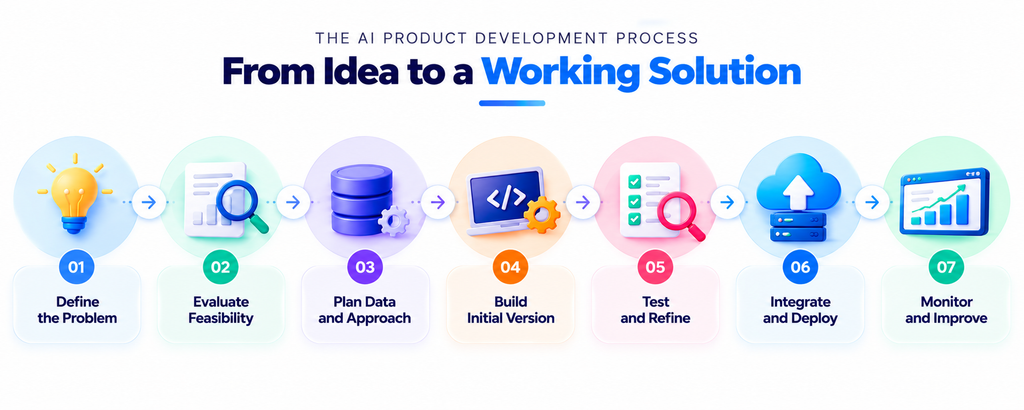
Building an AI product involves more than selecting a model and writing code. These stages help move an idea towards a solution that can be evaluated in real use.
Step 1: Define the problem
Identify who will use the product, what they need to do, how the task is handled today, and what measurable improvement would make the project worthwhile. For example, “reduce the time employees spend finding information in company documents” is a clearer objective than simply “build an AI assistant.”
Step 2: Evaluate feasibility
Assess whether the idea is technically and commercially practical. Consider available data, task complexity, operating costs, integrations, and the consequences of incorrect results. An assessment may show that an existing model—or even conventional software—can solve the problem without building a new AI system.
Step 3: Plan the data and AI approach
Determine what information the solution needs and whether it must be collected, cleaned, labelled, or connected securely. The team should also decide whether to use an existing model, adapt one for a specific task, or develop a specialised model. For example, a document-search tool may combine an existing language model with a retrieval system that supplies relevant information from approved company documents.
Step 4: Build an initial version
Create a limited application, working demonstration, or proof of concept that tests the most important assumption. The purpose is to find out whether the approach solves the problem well enough to justify further investment before building every feature.
Step 5: Test realistic scenarios
Test ordinary use as well as incomplete information, unexpected requests, incorrect inputs, and situations where the system should acknowledge uncertainty or hand a task to a person. Evaluation may include accuracy, task completion, response time, consistency, operating cost, privacy, and the impact of errors. The NIST AI Risk Management Framework provides guidance on managing AI-related risks throughout a system’s lifecycle.
Step 6: Integrate and deploy
Connect the AI component to the wider product and workflow. This may involve databases, APIs, user accounts, existing software, access controls, and reporting tools. Plan for performance, data handling, permissions, and what should happen if the AI service is unavailable or produces an unsuitable result.
Step 7: Monitor and improve
After launch, review performance, user feedback, costs, and new types of input. Use this evidence to identify errors and prioritise improvements. The level of monitoring and human oversight should reflect the product’s purpose and the potential impact of its decisions.
4. Choosing the Right AI Approach
Different approaches suit different tasks. Choosing technology before understanding the use case can add unnecessary complexity and cost.
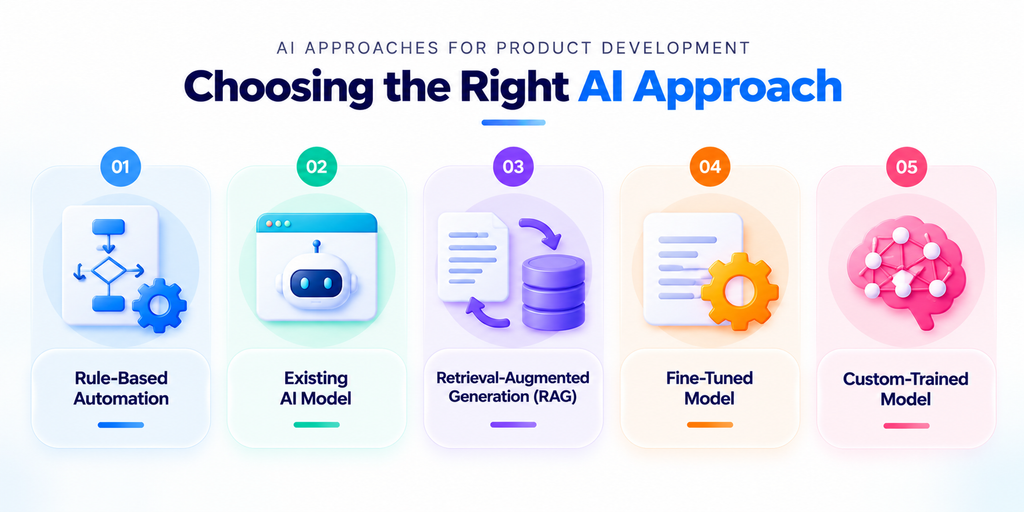
| Approach | Suitable use | Key consideration |
| Rule-based automation | Predictable tasks with clear conditions | Best when rules are known and stable |
| Existing AI model | General language, image, or classification tasks | Check performance, limits, cost, and data handling |
| Retrieval-augmented generation (RAG) | Answering questions using a defined document collection | Depends on document quality and retrieval accuracy |
| Fine-tuned model | Tasks that benefit from specialised examples or behaviour | Requires suitable data and evaluation |
| Custom-trained model | Specialised needs not adequately met by existing options | Can require substantially more data, expertise, and resources |
These methods can be combined. For example, software rules can control access to sensitive information while an AI model interprets a user’s question. The best solution is the one that meets the requirements at an acceptable level of cost, risk, and complexity—not necessarily the most advanced one.
5. What to Consider Before Investing in AI Product Development
A promising idea still needs a realistic plan. Consider these factors before committing resources.
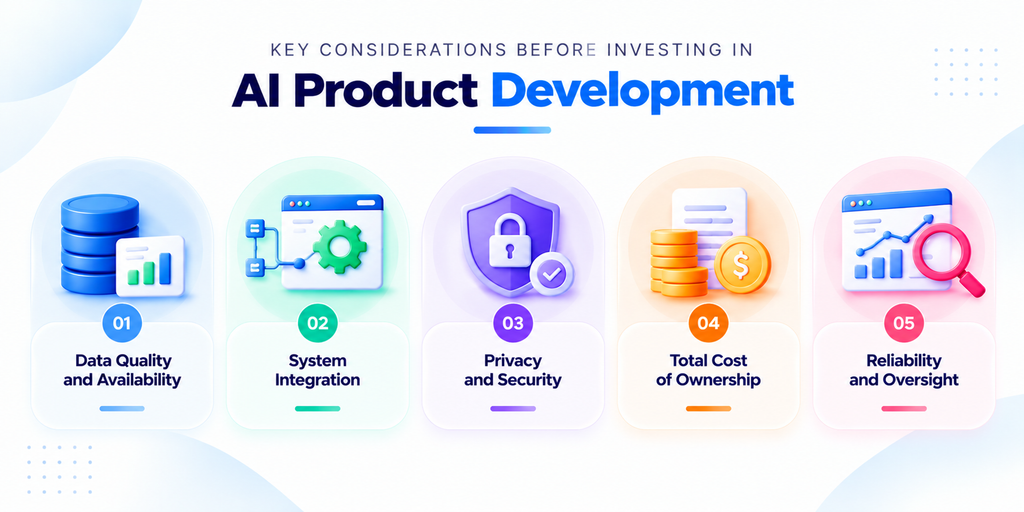
- Data quality and availability: Incomplete, outdated, inconsistent, or unsuitable data can limit performance. Identify what information is available, whether it can appropriately be used, and what preparation is needed.
- Integration: A product may need to connect with business software, databases, websites, or connected devices. Identify these requirements early because they affect architecture, effort, and maintenance.
- Privacy and security: Understand what information the system will access, where it will be processed, who can use it, and how it will be protected. Assess relevant legal and regulatory requirements, especially for personal or confidential information.
- Reliability and human oversight: AI outputs can be wrong or incomplete. Plan how the system should handle uncertainty, unexpected inputs, and cases that need human judgement.
- Total cost of ownership: Development is only part of the investment. Ongoing expenses may include model usage, cloud infrastructure, data storage, monitoring, maintenance, security updates, and future improvements.
6. Common Mistakes in AI Product Development
Several avoidable mistakes can make a project more expensive or less useful:
- Starting with technology instead of the problem: A feature may look impressive but deliver little practical value if it does not address a real need.
- Assuming the data is ready: Information may require substantial cleaning, organisation, or labelling.
- Expecting perfect results: Testing, safeguards, and ways to handle errors are essential.
- Ignoring integration: An AI component may work on its own but fail to fit the business workflow.
- Underestimating ongoing costs: Infrastructure, model usage, maintenance, and monitoring continue after launch.
- Skipping post-launch evaluation: Real usage can differ from development assumptions.
Define success criteria early, test the riskiest assumptions, and improve the product using evidence.
7. How to Choose an AI Product Development Company
The right development partner should understand the business problem as well as the technical requirements. Before choosing an AI product development company, ask about:
- Relevant experience: Request examples of comparable projects and clarify what the team actually delivered.
- Clear explanations: The team should explain why its proposed approach fits, what limitations remain, and what alternatives exist.
- Development and integration capabilities: Check whether it can provide the components your project needs, such as AI, backend software, APIs, cloud infrastructure, or hardware integration.
- Testing and risk management: Ask how performance is measured, data is protected, and incorrect outputs are handled.
- Scope and communication: Agree on deliverables, milestones, responsibilities, costs, dependencies, and how changes will be managed.
- Maintenance and support: Establish who will monitor the product, resolve issues, and manage updates after launch.
A reliable partner is transparent about trade-offs and limitations rather than promising that AI can solve every problem.
8. How to Measure AI Product Success
Success depends on the product’s purpose.
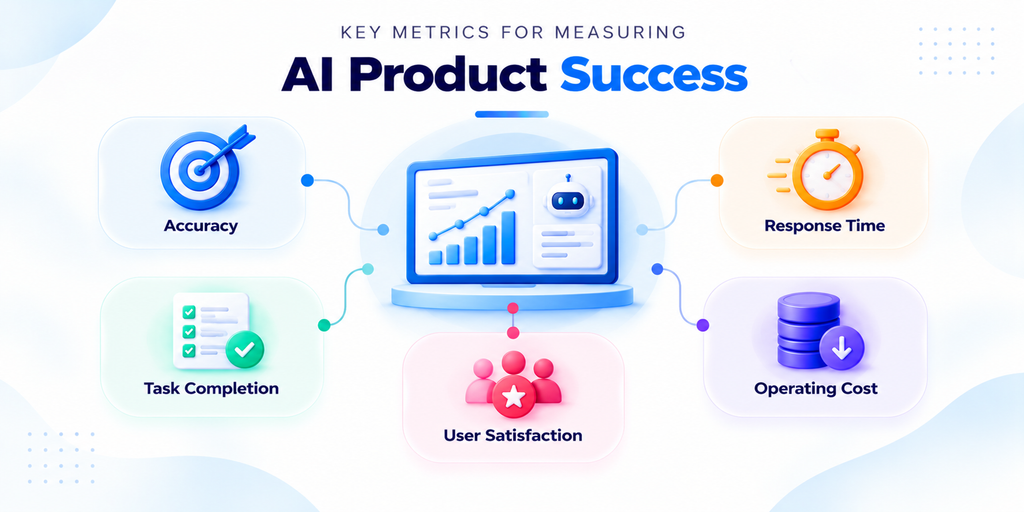
For customer support, useful measures may include resolution time, response quality, escalation rates, and customer satisfaction. For visual inspection, measures might include defect-detection performance, false positives, processing speed, and the cost of errors.
Record how the current process performs before development begins, then set realistic targets and compare results. Assess the complete workflow too: faster automated processing may not create value if employees spend extra time correcting outputs.
A successful AI product should improve a measurable business outcome while meeting appropriate requirements for reliability, security, usability, and cost.
Frequently Asked Questions
How long does AI product development take?
It depends on complexity, data availability, integrations, testing, and team capacity. A limited proof of concept may take much less time than a production-ready product. A realistic timeline follows an assessment of the scope.
How much does AI product development cost?
Costs depend on features, data preparation, model choice, integrations, infrastructure, and ongoing support. Existing models can reduce the need for custom training, but application development and integration still require work. Ask for an estimate based on your specific requirements.
Does every AI product need a custom-trained model?
No. Many products use existing models, sometimes combined with retrieval systems, conventional software, or fine-tuning. Custom training is justified only when the requirements warrant the additional data, expertise, and resources.
What data is needed?
It depends on the task. A project may use documents, images, transaction records, sensor readings, or labelled examples. Data should be relevant and representative, and it must be handled according to applicable privacy and security requirements.
Can AI be integrated into existing business software?
Yes. Integration may use APIs, databases, connectors, or other interfaces. Feasibility depends on system access, compatibility, security, and the intended workflow.
How do you measure AI performance?
Choose metrics that reflect the product’s purpose, such as accuracy, task completion, response time, error rate, cost, or user satisfaction. Test realistic scenarios and monitor performance after deployment.
What is the difference between a proof of concept and a finished product?
A proof of concept tests whether an approach is feasible. A production-ready product also needs suitable integration, security, user experience, testing, deployment, monitoring, and maintenance.
What should I prepare before contacting a development company?
Describe the problem, intended users, current workflow, desired outcome, available data, existing systems, and any constraints. You do not need a complete technical specification to begin the conversation.
Next Steps: Turning an Idea into a Practical AI Solution
If you are considering an AI-powered product:
- Identify one business problem worth solving.
- Describe the current process and what needs to improve.
- Review the data and systems available.
- Assess whether AI offers an advantage over simpler alternatives.
- Define measurable success criteria and key risks.
- Discuss feasibility, scope, and implementation options with a suitable development team.
A focused starting point helps you evaluate the opportunity before committing to a larger investment.
How Devomech Can Help
Devomech works across software and engineering disciplines, including AI-related solutions and product development. For businesses exploring an AI-powered product, the first step is to understand its intended function, technical requirements, and practical constraints. The appropriate approach can then be assessed against the project rather than assuming one technology fits every use case.
If you have a product idea or a business process you want to improve, contact Devomech to discuss your requirements and explore possible next steps.
Sources & References
- National Institute of Standards and Technology (NIST): AI Risk Management Framework.
- NIST: AI Risk Management Framework FAQs.
- Devomech: Official website.