

TL;DR
Electronic product development is the process of turning an idea into a reliable electronic device that can be certified, manufactured and sold. It combines requirements, circuit design, PCB layout, firmware, enclosure design, testing, certification and production preparation. The projects that succeed define requirements clearly, choose components with availability in mind, test early against EMC and safety rules, and design for manufacturing from the start.
Introduction
From smart home controllers and battery chargers to industrial sensors and motor drives, almost every modern product contains electronics. Yet turning a working breadboard into a product that passes certification and can be built by the thousand is a very different challenge.
A circuit that works on the bench can fail EMC testing, overheat inside an enclosure or depend on a chip that goes out of stock. Many of these problems can be avoided with a structured electronic product development process.
This guide explains what electronic product development involves, the engineering disciplines behind it, the step-by-step process, testing and certification, component sourcing, what drives cost and how to choose the right development partner.
1. What Is Electronic Product Development?
Electronic product development is the end-to-end process of designing, prototyping, testing and preparing an electronic device for mass production. It covers everything from the first specification to a validated design that a contract manufacturer can build consistently. It is the electronics-focused part of wider hardware product development.
It applies to a wide range of products, including:
- Consumer devices such as chargers, audio products and smart home controls
- Industrial electronics such as sensors, controllers and motor drives
- Battery-powered and portable devices
- Embedded control boards inside larger machines and equipment
Some products are connected, others are not. For connected devices, see our guide to IoT product development.
2. The Core Disciplines of Electronic Product Design
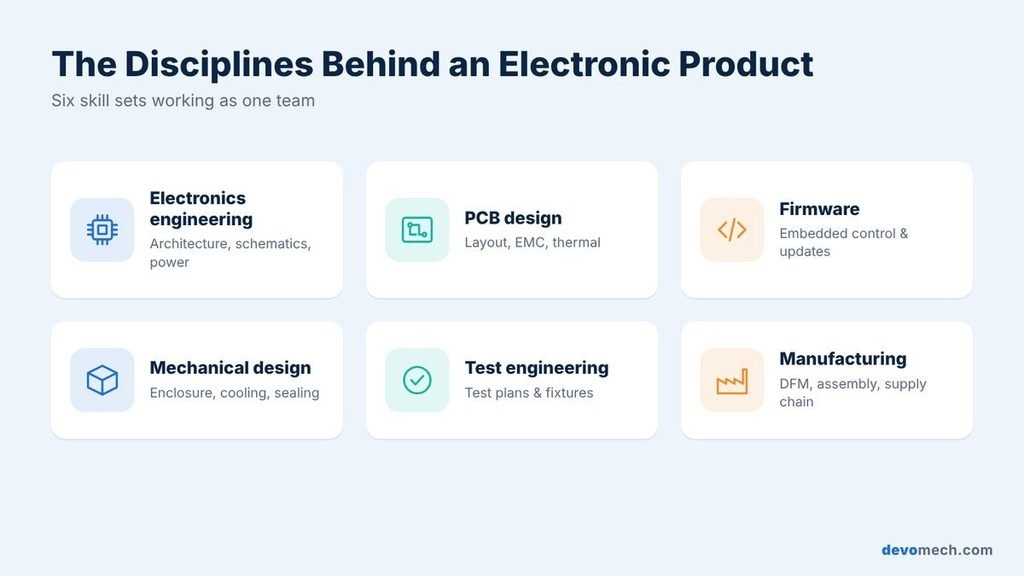
Good electronic product design brings several specialist skills together:
- Electronics engineering: system architecture, schematic design, power supply design and component selection.
- PCB design: layout, stack-up, routing, signal integrity, thermal management and EMC-aware design.
- Firmware engineering: embedded code that controls the hardware, manages power and handles communication.
- Mechanical and enclosure design: housing, mounting, cooling, sealing and user interface.
- Test engineering: test plans, test fixtures and production testing.
- Manufacturing engineering: design for manufacturing (DFM), assembly and supply chain planning.
When these disciplines work together from the start, the result is a product that performs well and is easier to certify and build.
3. The Electronics Product Development Process
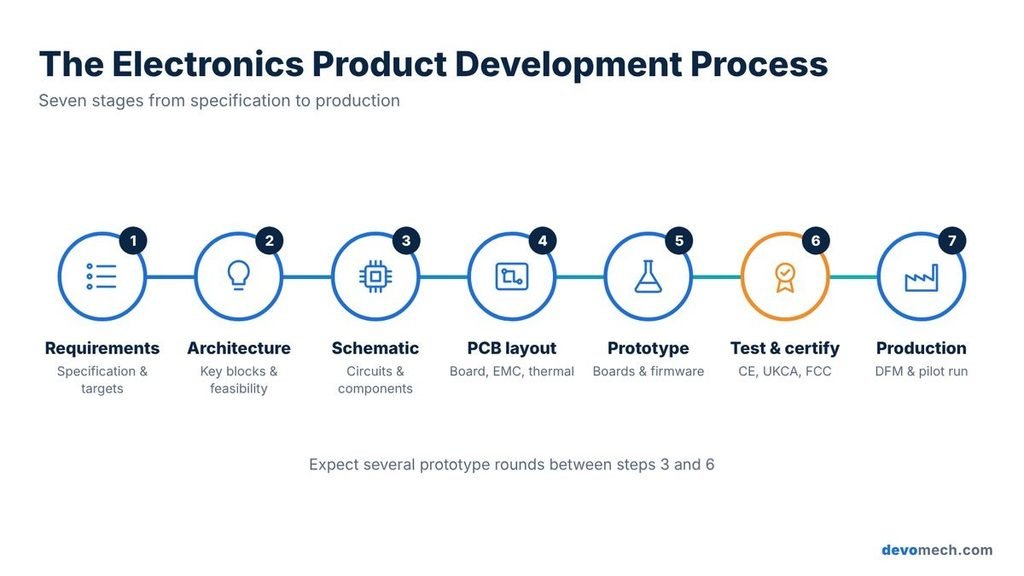
Step 1: Requirements and specification
Define what the product must do, where it will be used, its power source, size, target cost, volume and target markets. A clear specification prevents expensive changes later.
Step 2: System architecture and feasibility
Choose the main building blocks: processor or microcontroller, power architecture, sensors, interfaces and communication. Check feasibility and the riskiest assumptions early.
Step 3: Schematic design and component selection
Engineers create the circuit schematics and select components for performance, cost, availability and lifecycle. Simulation helps check critical circuits before hardware is built.
Step 4: PCB layout
The schematic becomes a physical board. Layout decisions affect EMC, heat, signal quality, assembly yield and cost. Our high-quality PCB design guide covers this stage in detail.
Step 5: Prototyping and firmware development
The first boards are built and brought up, while firmware is developed and tested on real hardware. Several prototype rounds are normal as issues are found and fixed. See our guide to product prototype development.
Step 6: Testing and certification
Functional, environmental, reliability and pre-compliance testing confirm the design is ready. Formal certification follows for each target market.
Step 7: Production preparation
A design for manufacturing review, test fixtures and a pilot run prepare the product for volume production with a contract manufacturer.
4. Testing and Certification
Most electronic products must meet legal requirements before they can be sold. The exact rules depend on the product and market, but these are the most common.
| Market / requirement | What it covers | Typical tests |
| CE marking (EU) | EMC, electrical safety, radio (if wireless), RoHS | EMC emissions and immunity, safety, radio tests |
| UKCA (Great Britain) | Similar scope to CE for the GB market | Usually based on the same test reports |
| FCC (USA) | Radio frequency emissions and radio devices | Unintentional and intentional radiator tests |
| RoHS and REACH | Restricted hazardous substances | Material declarations and supplier data |
| Product safety standards | Electrical and fire safety | Testing to standards such as IEC 62368-1 for electronics and IT equipment |
Pre-compliance testing during development is one of the best ways to avoid failing formal tests and redesigning boards late in the project.
5. Component Sourcing and Lifecycle Management
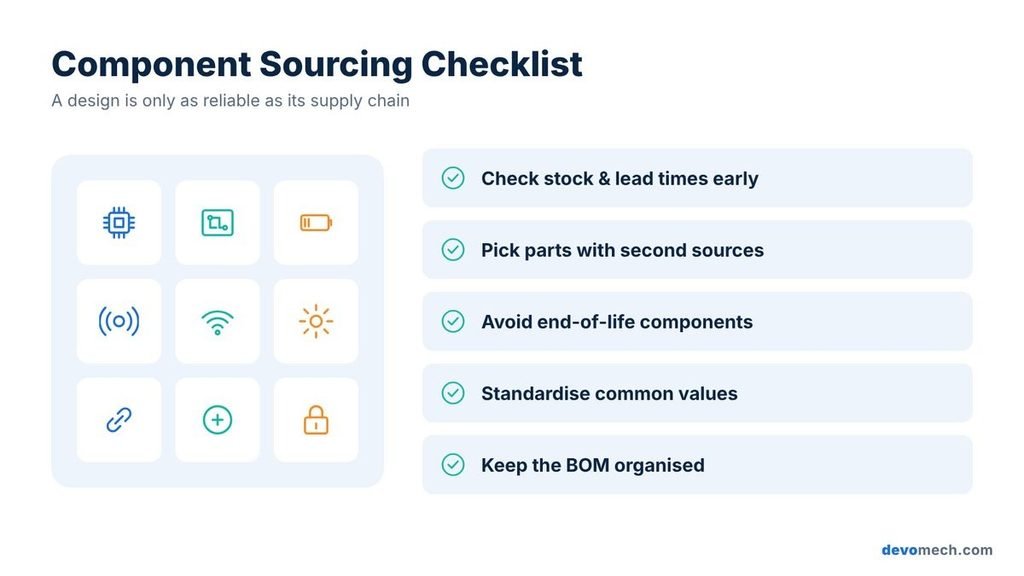
Recent chip shortages showed how much component choices matter. A design is only as reliable as its supply chain. Good practice includes:
- Check availability early: confirm stock, lead times and multiple distributors before committing to a part.
- Choose second sources: select parts with pin-compatible alternatives where possible.
- Watch lifecycle status: avoid components marked as not recommended for new designs or near end-of-life.
- Standardise parts: reuse the same resistor, capacitor and connector values to simplify purchasing.
- Plan for change: keep the bill of materials (BOM) and design files organised so parts can be replaced quickly.
6. What Affects the Cost of Electronic Product Development?
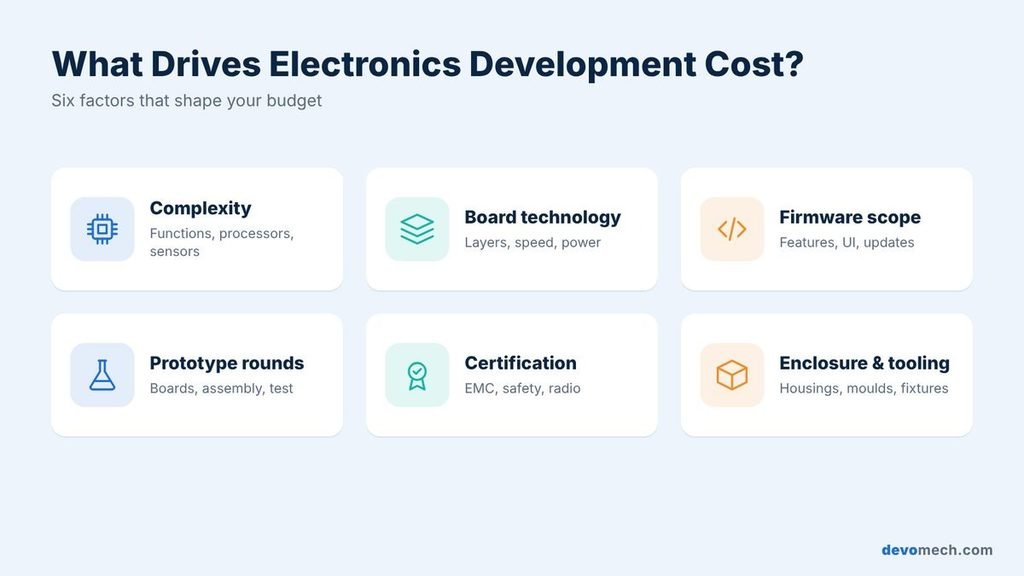
Every project is different, but these factors drive the budget most:
- Complexity: number of functions, processors, sensors and interfaces.
- Board technology: layer count, high-speed signals, fine-pitch components and power levels.
- Firmware and software scope: features, user interface, connectivity and updates.
- Number of prototype rounds: each revision adds board, assembly and test costs.
- Certification: EMC, safety and radio testing for each target market.
- Enclosure and tooling: custom housings, moulds and test fixtures.
- Production volume: affects component pricing, manufacturing method and tooling decisions.
The most reliable figure is an estimate based on a clear specification and target volume.
7. Common Mistakes in Electronic Product Development
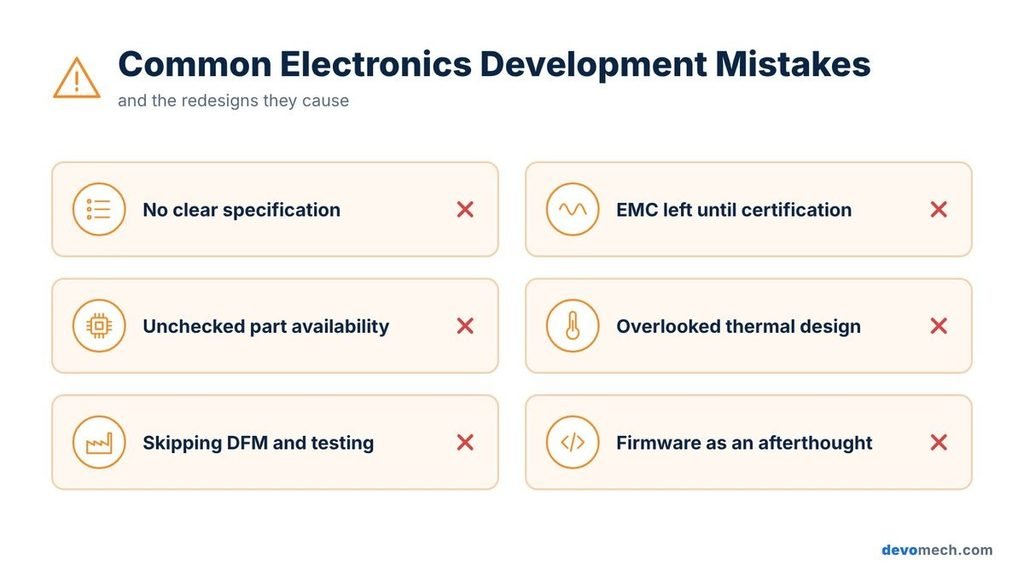
- Starting design without a clear specification.
- Ignoring EMC until certification: fixes at the end often need a new board revision.
- Choosing parts without checking availability: a single-source chip can halt production.
- Overlooking thermal design: electronics that run hot inside an enclosure fail early.
- Skipping design for manufacturing and testing: boards that are hard to assemble or test cost more to build.
- Treating firmware as an afterthought: hardware and firmware should be developed together.
8. How to Choose an Electronics Design Company
The right partner can shorten your time to market and reduce risk. Look for an electronics design company that offers:
- End-to-end capability: electronics, PCB design, firmware and mechanical design under one roof.
- Relevant experience with products like yours, from battery-powered devices to industrial electronics.
- Certification knowledge: experience preparing products for CE, UKCA and FCC.
- Manufacturing readiness: DFM expertise and relationships with PCB assemblers and contract manufacturers.
- Clear communication: defined milestones, documentation and regular design reviews.
Frequently Asked Questions
How long does electronic product development take?
Simple products can move from concept to production-ready design in a few months, while complex products with multiple prototype rounds and certifications often take a year or more.
What is the difference between electronic product design and development?
Design usually refers to creating the circuits, PCB and enclosure. Development is the wider process, including prototyping, firmware, testing, certification and production preparation.
Do I need certification for my electronic product?
Almost always. Products sold in the EU need CE marking, and products sold in the US need FCC compliance for RF emissions. Wireless and mains-powered products usually need additional testing.
How many prototypes will I need?
Most products go through two to four prototype rounds, from early proof of concept to a pre-production version.
Can you redesign an existing electronic product?
Yes. Redesigns are common to reduce cost, replace obsolete components, add features or improve reliability.
Next Steps: Turning Your Idea Into an Electronic Product
- Write a clear product specification, including target cost and volume.
- Identify your target markets and their certification requirements.
- Validate the riskiest technical assumption with a proof of concept.
- Choose components with availability and lifecycle in mind.
- Plan prototype rounds, testing and a pilot production run.
- Work with an experienced engineering team from design to production.
How Devomech Can Help
Devomech offers electronic product development services from concept to production. Our team brings together electronics design, PCB layout, embedded firmware and mechanical engineering, with manufacturing considered from day one. We support custom electronics development for startups and established companies, including prototyping, certification preparation and production handover. Learn more about our hardware product design services.
Have an electronics product idea? Contact Devomech to discuss your requirements.